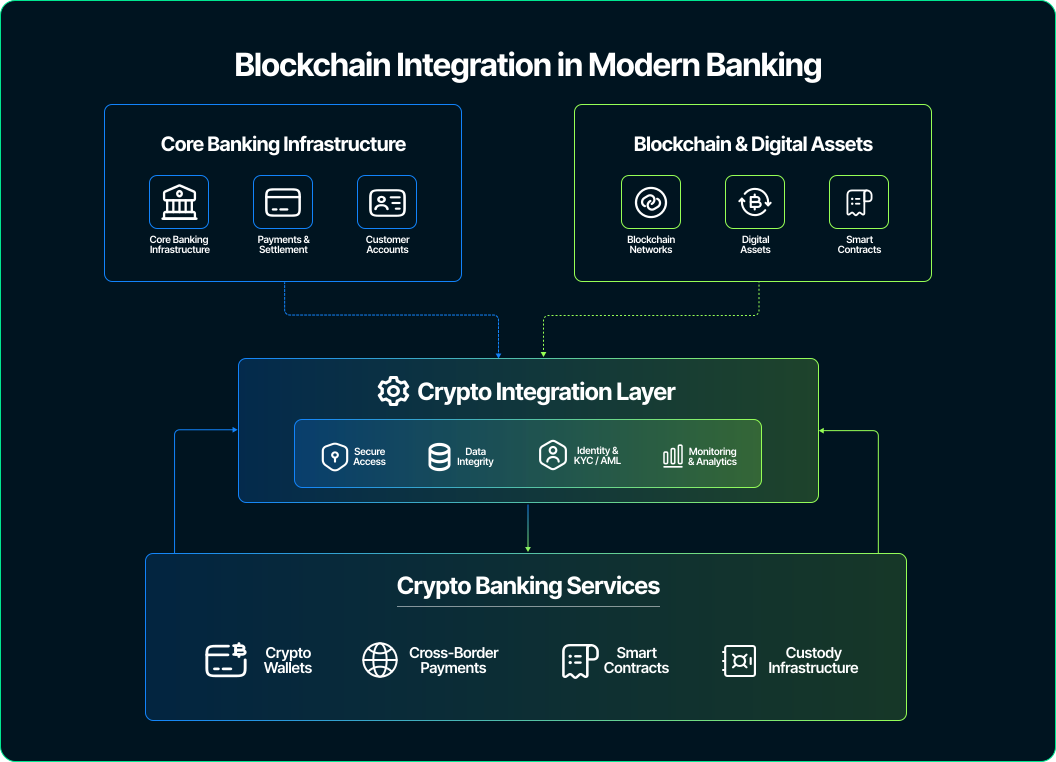
Crypto banking software connects digital-asset transactions with customer accounts, payment operations and the bank's internal records. A project must define who controls the keys, which assets and networks it supports, when a transfer is treated as settled, and how transactions are reconciled and reviewed. This article explains those integration decisions and the engineering capabilities needed to implement them.
Why Blockchain Development Services Matter for Banks and Financial Institutions
1. Payment and Settlement Options
Stablecoins can support transfers outside traditional banking hours. End-to-end settlement time and cost still depend on the network, payment providers, conversion steps and compliance checks. Compare the complete payment route, including how the recipient receives usable funds, rather than treating a blockchain confirmation as the entire service.
CPMI's report on cross-border stablecoin arrangements discusses these opportunities and constraints.
2. New Revenue Streams Through Crypto Solutions
Custody, tokenized deposits and crypto brokerage are possible service models, each with different operational and regulatory requirements. Before selecting one, define the customer need, supported assets and the institution's responsibilities for holding assets, executing transactions and handling recovery.
Wallet software is only one component: the service also needs account records, transaction controls, monitoring and support processes. The custody model determines which party can authorize transfers and recover access.
3. Transaction Records and Smart Contracts
A blockchain provides a shared transaction history that can support auditing and reconciliation, but the bank still needs to connect that history to its own customer and ledger records. Smart contracts can enforce coded conditions; they do not by themselves establish the accuracy of external data or complete regulatory compliance.
4. Competitive Pressure from Fintech and Digital Banking
Fintech and digital-bank services give institutions new options to evaluate. The useful question is which customer or operational problem a blockchain-based service would solve, and whether it offers a better fit than the available conventional payment or account infrastructure.
Blockchain Development Services for Banking System Integration
1. Custom Software Development and Core Banking Integration
Blockchain transactions need to be mapped to the institution's account and ledger records. Where a bank interface or payment scheme uses
ISO 20022, the integration must also map the required business data to the relevant messages.
The integration needs an agreed mapping between transaction identifiers, account entries and payment statuses. It also needs rules for retries, duplicate messages and exceptions, so a provider timeout or delayed confirmation does not silently produce conflicting records.
2. Crypto Wallet Development and Custody Infrastructure
Banks need secure infrastructure for storing and managing private keys. Multi-party computation (MPC) can distribute signing work across participants; hardware security modules (HSMs) protect keys and cryptographic operations within dedicated hardware. Neither is a complete custody model on its own. Online signing systems support day-to-day transfers, while offline key storage limits connectivity; both need authorization rules, recovery procedures and operational testing.
3. Blockchain Development and Smart Contract Programming
Direct node operations or third-party providers give banks access to relevant blockchains, with monitoring for finality, chain reorganizations and network reliability. A reorganization can replace recent chain history. How the service decides it can rely on a transaction depends on the network's finality and confirmation rules, as well as the institution's risk policy. The integration must also handle provider outages. Smart-contract language and tooling should be selected for that network, rather than assuming every blockchain uses Solidity.
4. Compliance and AML/KYC for Cryptocurrency Operations
The compliance workflow must be designed for the jurisdictions, assets and business roles in scope. It may include customer checks, wallet-address screening, transaction monitoring and transfer information required by the applicable Travel Rule provisions. Blockchain analytics can support investigation and risk scoring, but does not replace the institution's decisions, records or reporting obligations.
FATF's virtual-assets guidance provides international context; local requirements still need to be established.
These checks need to connect to the institution's case-management and review processes, with clear ownership of alerts, approvals and required records.
5. Settlement and Reconciliation Systems
Reconciliation compares on-chain transfers, provider records and internal ledger entries, with timing and exception handling defined for the service. A blockchain confirmation is not by itself evidence that conversion, payout or internal posting has completed. For stablecoin arrangements, proof-of-reserves reports and financial-statement audits answer different questions:
proof of reserves is not an audit.
6. Resilience and Security Architecture
Incident response plans, segregation of duties and reporting processes are part of operational resilience. Define who can pause transfers, investigate a signing or provider failure, approve recovery and resume service. Test these procedures alongside access controls and backup arrangements; a named wallet product is not evidence that the overall service is secure.
Practical Use Cases: Blockchain Development in Banking
Cross-Border B2B Payments with Stablecoins
A cross-border stablecoin payment needs more than an on-chain transfer: the service must handle funding, address validation, transfer monitoring and the recipient's payout or conversion. Its end-to-end cost and completion time depend on that entire route, the network and compliance checks; they are not guaranteed to be lower or faster than conventional alternatives.
Fintech Software Development and Merchant Settlement
Merchant settlement can connect a stablecoin payment to the merchant's order, conversion instruction and payout record. Define the settlement currency, exchange-rate handling, refund process and reconciliation with the point-of-sale or commerce system. Whether this improves cash flow depends on the complete provider and payout arrangement.
High-Net-Worth Client Services
A bank offering custody or trading to high-net-worth clients needs clear account ownership, transfer approvals, recovery arrangements and service reporting. Client-facing wallet interfaces must fit that operating model; consumer-product popularity does not establish suitability for institutional custody.
Smart Contract Development Services for Banks
Smart contracts can automate defined steps such as releasing funds when coded conditions are met. The design must also address the reliability of external data, who can change the contract and how exceptions are handled. Identity checks, legal review and reporting remain part of the wider service rather than becoming automatic simply because a contract runs on-chain.
Liquidity Management and DeFi Integration
On-chain treasury or lending services need limits on exposure, approved counterparties or protocols, and a process for monitoring positions. Assess contract failures, collateral values, liquidation behavior and exit options. Visibility into transactions does not remove these risks.
Choosing the Right Blockchain Development Services Partner
Implementing cryptocurrency capabilities requires specialized expertise. When evaluating
software development companies, banks should look for proven experience in
blockchain development, regulatory compliance and enterprise integration. The best partners combine
blockchain development services with deep financial sector knowledge.
Evaluate the delivery arrangement against the work: access to the bank's subject-matter experts, overlap for incident handling, data-access restrictions and ownership of operational support. Team location or a named development methodology is not a substitute for evidence that the integration can be delivered and maintained.
Key Development Services Capabilities to Evaluate
For crypto banking, ask for relevant examples of ledger integration, key management, transaction monitoring and the supported blockchain interfaces. Distinguish a wallet or lending prototype from a production banking integration, and check which responsibilities belonged to the supplier in each example.
Strong project management becomes critical when coordinating blockchain teams, compliance specialists and legacy-system integrators. Ask how the team reviews security-sensitive changes, tests integration failures, controls production releases and hands over runbooks and support responsibilities.
Technology Architecture for Modern Crypto Banking
A crypto banking application needs a customer or operator interface, APIs for permitted actions, transaction-processing services and connections to custody providers, blockchain nodes and the core banking system. Keep the responsibility of each layer explicit, especially which system owns account balances, payment status and the final ledger entry.
Authentication and authorization should follow the institution's identity architecture. JWT is a token format that can carry identity or access claims; it is not an authentication system by itself. An implementation must
validate tokens according to the selected protocol, including their cryptographic protection, issuer and intended audience. Session handling and additional authentication factors require their own design decisions.
Cryptocurrency Wallet Development Solutions Across the Spectrum
In a custodial service, the provider controls the signing keys or the signing process on the client's behalf. In a self-custody model, the client controls the keys. Those choices change transfer authorization, recovery and support responsibilities. Insurance, privacy and regulatory treatment must be evaluated separately; they do not follow automatically from either label.
Choose the custody model before selecting wallet products. Define who can authorize transfers, how keys are created and protected, how recovery works, and what happens when a device or operator becomes unavailable. Hardware protection is one part of that design; access controls, operational procedures and recovery testing also need to be evaluated.
NIST's key-management guidance covers the key lifecycle; it does not certify a particular wallet or service.
Advanced Blockchain Development Services for Financial Institutions
Additional trading or asset-service features should follow a defined business requirement. Each adds questions about transaction authorization, market-data dependencies, exposure limits and integration with the institution's books. A feature catalogue is not a substitute for specifying those controls.
For lending, define the collateral model, valuation inputs, repayment rules and liquidation or default handling before choosing the implementation. A collateral-backed smart-contract loan and an unsecured credit product have different requirements. The lending MVP linked below illustrates a collateral-backed workflow, not evidence that a bank can safely offer unsecured crypto loans.
Software Development Services and Outsourcing Strategies
External teams can provide specialist engineering capacity, but the delivery agreement should make responsibilities explicit: architecture decisions, access to sensitive systems, security review, acceptance testing and production support. The institution still needs owners for business, operational and compliance decisions.
For any delivery model, agree how defects and incidents are escalated, how knowledge is transferred and who maintains the integration when provider APIs, network behavior or regulatory requirements change.
Conclusion: The Future of Crypto Banking
Crypto banking integration should start with a defined payment or asset-service problem, not a promise that blockchain automatically makes every operation faster, cheaper or compliant. Success depends on how the service connects transaction handling, account records, custody, controls and support.
A useful project brief identifies the target jurisdictions, supported assets and networks, custody model, settlement expectations and the systems that must exchange data. Those decisions make scope, responsibilities and acceptance tests concrete.
For a scoped engineering example, see our
crypto-backed lending MVP, covering wallet connection, collateral handling and smart-contract loan workflows. To discuss banking integration, start with those requirements and the systems that must exchange data.