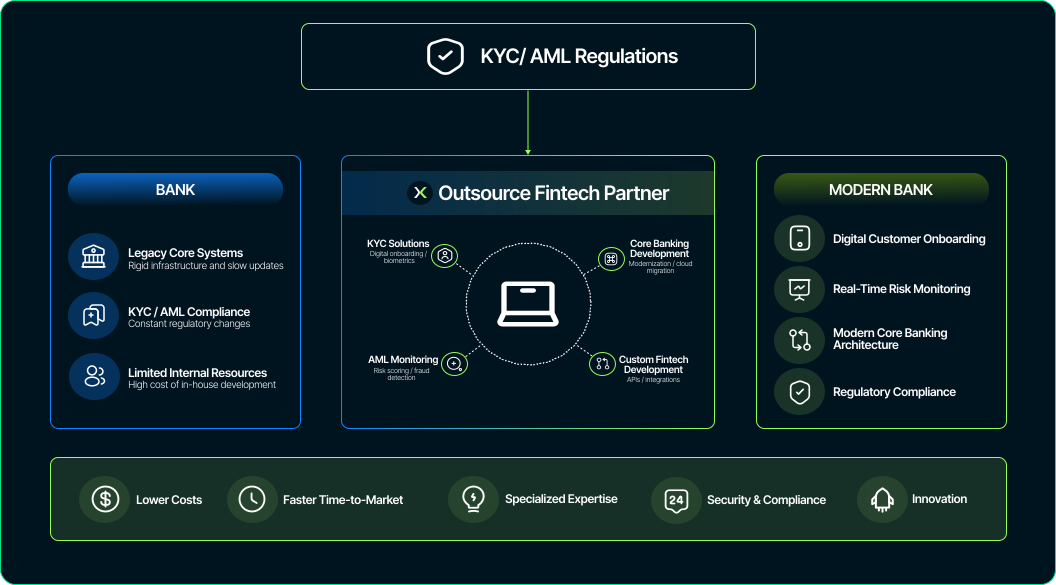
KYC/AML outsourcing can mean outsourcing the checks themselves, using a verification provider's API, or hiring engineers to build the supporting software. These scopes can be combined, but they are not interchangeable:
- Managed operations: an external team reviews customer information and handles cases within an agreed remit.
- Vendor APIs: a provider supplies specific checks or screening results; the bank still needs workflows for using those results.
- Software engineering: developers connect those services to onboarding, staff review tools and existing banking systems.
This article covers Intelexity's software development and integration work. It does not describe a managed KYC operations service performing day-to-day checks.
1. Defining the KYC/AML Software Scope
Requirements for Know Your Customer compliance and Anti-Money Laundering compliance continue to expand. Depending on the bank's requirements, the software may support monitoring, risk scoring, biometric verification and jurisdiction-specific workflows. However, those controls must work inside the existing customer journey.
An external engineering team can connect selected verification providers, implement review tools and adapt customer journeys to the bank's requirements. The bank defines the policies and review responsibilities; the software supports their execution. Changes in processing time, review workload and error rates should be measured against the existing process.
2. Banking Software Outsourcing: Efficiency and Scalability
Core banking systems remain the operational backbone of a financial institution. Yet many banks still depend on tightly coupled legacy platforms. Replacing the entire core is expensive and risky. Therefore, modular banking software outsourcing often provides a safer path.
Intelexity supports banks with custom enterprise software development, cloud migration and integration work. In practice, the team modernizes one bounded capability at a time. The migration plan must address downtime, rollback and protection of sensitive data. Delivery can use a time-and-material model or a dedicated team for long-term fintech software development.
3. Cost Optimization Through IT Outsourcing Services
Maintaining specialist engineering capacity in-house can be costly. In addition, specialist demand changes across a transformation program. An experienced IT outsourcing company can provide capacity when it is needed. Banks can retain ownership of policy and architecture while comparing the total cost of external delivery, internal oversight and ongoing maintenance.
Cost control should not mean weaker governance. Instead, responsibilities, evidence and service levels must be defined before work begins. This makes delivery measurable and keeps accountability with the bank.
4. Custom Fintech Development and Compliance Automation
Fintech companies and digital banks continue to raise customer expectations. Meanwhile, regulators expect stronger evidence and more consistent controls. Custom fintech development can connect both requirements through secure digital onboarding, automated case management and real-time fraud detection.
For example, a modern KYC workflow can combine document validation, biometric verification and sanctions screening. It can then route uncertain cases to a human reviewer. Processing time and review quality should be measured together.
Intelexity focuses on the surrounding engineering system as well as the individual feature. That includes integration contracts, access control, audit trails, deployment automation and operational monitoring. These controls support the bank's compliance processes; they do not replace policy decisions or human oversight.
5. Bank Accountability and Delivery Controls
Outsourcing IT development can improve operational resilience through support coverage, incident response and tested recovery procedures. The bank must still control policy, risk acceptance and evidence retention. For example, U.S. banking agencies' third-party risk guidance makes clear that engaging a provider does not remove the bank's responsibilities. Specific obligations depend on the institution, activity and jurisdiction.
A sound delivery model combines information security, data protection and identity management. Controls should be mapped to the legal, security and contractual requirements that apply to the specific system and jurisdiction. Finally, regular security reviews and risk assessments should verify that those controls still work in production.
Conclusion: Define the Outsourcing Scope First
Banks use external engineering teams to develop and integrate KYC/AML software alongside targeted core banking modernization. The strongest programs do more than move work to an external team. They define decision rights, technical boundaries and measurable operating controls.
Intelexity provides outsourced fintech teams across architecture, compliance integration, QA, DevOps and core banking transformation. Ultimately, the objective is not outsourcing for its own sake. It is a controlled delivery model with clear responsibilities for software delivery, security and regulatory ownership.
See our KYC system case study for document verification, biometric checks and staff review tools, or explore our fintech and banking development services.