
KYC System
Intelexity developed a KYC platform for a bank's digital onboarding, connecting customer document submission with staff review of verification results and reporting. Customers upload identity documents and complete biometric checks through web or mobile interfaces.
The platform combines document text extraction, facial recognition and integrations with internal and external data sources. Bank employees use a control panel to track verification progress, inspect case details, manage risk alerts and generate reports. The delivered system brings customer-facing steps and the bank's operational tools into a shared verification workflow.
KYCMicroservicesAMLCFTOCRmonitoringonboarding
Development Duration
11 months
- Business Analyst
- PM
- Architect
- Back Developer
- Front Developer
- Mobile Developer
- QA
- DevOps
- SecOps
Technology Stack


Task
- The bank's need: The client needed to automate customer identification and verification, reduce manual work and make onboarding easier for customers. The solution had to work with the bank's existing IT infrastructure.
- Customer experience: Customers needed an online process for submitting identity documents and following their verification status. Document submission and biometric checks had to fit the bank's web and mobile channels.
- Compliance support: The brief included the bank's customer-verification requirements and the relevant anti-money laundering (AML) and counter-terrorism financing (CFT) processes. Software needed to support these requirements within the customer and employee workflows.
- Operational flexibility: Staff needed tools to monitor verification, inspect cases and work with risk alerts and reports. The system also needed to accommodate updates and growth as the bank's requirements changed.
What was done
- Document processing: We implemented optical character recognition (OCR) within the document-processing module to extract text from identity documents. The extracted information is used within the wider customer-verification workflow.
- Data integration: We connected internal and external data sources to the verification process. Information from these sources supports customer checks alongside the submitted documents.
- Customer interface: We built the interface for uploading documents and tracking verification status. It gives customers a way to complete the submission process through the bank's digital channels and follow its progress.
- Biometric checks: We implemented facial-recognition functionality as part of the customer-verification workflow. This brings biometric checks into the same process as document handling and data integration.
- Staff control panel: We built tools for monitoring and managing verification cases, viewing case details, handling potential-risk alerts and generating reports. This connects the customer-facing process with the information bank employees need for review.
How it works
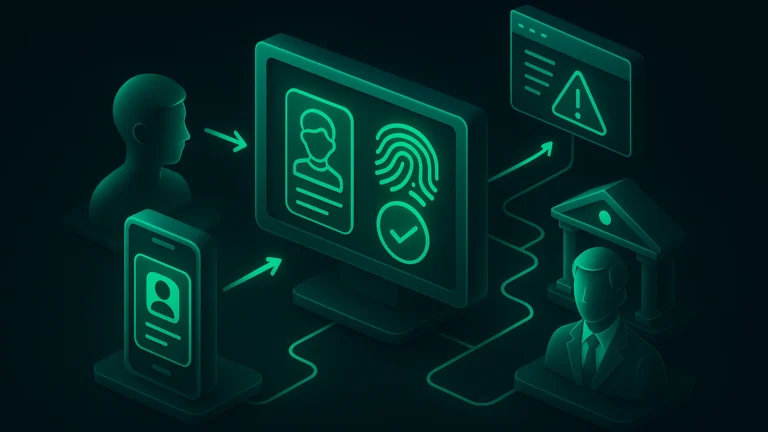
- Customer submission: Customers start verification through the bank's website or mobile app, upload their identity documents and complete biometric checks. They can track the status of their verification through the customer interface.
- Verification inputs: OCR extracts document text, facial-recognition functionality supports biometric checks, and connected data sources contribute information to the verification process. The platform connects these functions within the workflow that bank staff can monitor.
- Employee review: Bank staff follow verification progress in the control panel, inspect the information for each case, manage risk alerts and generate reports. The panel provides a shared operational view of the process.
- Operational outcome: Customer submissions, verification functions and staff tools are brought into a connected workflow. Routine document processing is automated, and staff can follow cases, manage alerts and generate reports within the same operational process.