
Most DevSecOps programs fail for a surprisingly ordinary reason: the company buys scanners before it decides what a secure release actually means.
The result is familiar. Static analysis produces thousands of findings. Container scans fail on vulnerabilities nobody owns. Developers learn which warnings can be ignored. Security receives more data but no better control over production risk. The pipeline becomes slower, while the release process remains fundamentally unchanged.
A useful DevSecOps implementation starts elsewhere. It defines the conditions under which software may move from source code to production, the evidence required at each transition and the people authorized to accept exceptions. Tools matter, but they implement that operating contract; they do not create it.
What DevSecOps implementation actually changes
DevSecOps is the integration of security work into the same delivery system used by engineering and operations. It is not a separate approval lane and it is not simply “security shifted left.” A mature implementation places controls across the entire software lifecycle: design, source control, build, test, release, deployment and runtime operations.
The NIST Secure Software Development Framework describes secure development as a set of practices that can be integrated into any software lifecycle. The OWASP DevSecOps Guideline makes the implementation model more concrete by covering threat modelling, secrets management, static and dynamic testing, dependency analysis, infrastructure scanning and container security.
For an engineering organization, this translates into five operational changes:
- security requirements become versioned delivery policy;
- every release produces machine-readable evidence;
- high-confidence failures can stop promotion automatically;
- exceptions have owners, expiration dates and audit trails;
- runtime signals feed back into development priorities.
The core design question is therefore not “Which scanner should we install?” It is “Which risk decision must be made at this point in the delivery path, and what evidence is good enough to make it?”
Why adding scanners to CI/CD is not enough
A CI/CD pipeline is an attractive enforcement point because it already connects code, build infrastructure, artifacts and deployment environments. That does not make every security check suitable for blocking a build.
Security tools operate with different levels of confidence. A leaked production credential is usually a deterministic failure. A critical vulnerability in an internet-facing runtime image may also justify an immediate block. A static-analysis finding based on incomplete data may need triage rather than automatic rejection. If every signal is treated as equally authoritative, teams either stop shipping or learn to bypass the system.
This is where many implementations degrade into alert forwarding. A tool reports a problem, the pipeline posts it to a dashboard, and no explicit release decision follows. The organization has automated detection but not control.
A real security gate needs four things:
- A defined scope. The policy knows which repository, service, environment and data classification it applies to.
- A decision rule. The outcome is pass, block, warn or require an approved exception.
- An owner. Someone is accountable for remediation or risk acceptance.
- Retained evidence. The organization can later explain what was checked, which rule was applied and why the release proceeded.
A reference architecture for a secure delivery pipeline
The implementation should follow the artifact from source to production. Each stage narrows what can enter the next stage and records evidence about the transition.
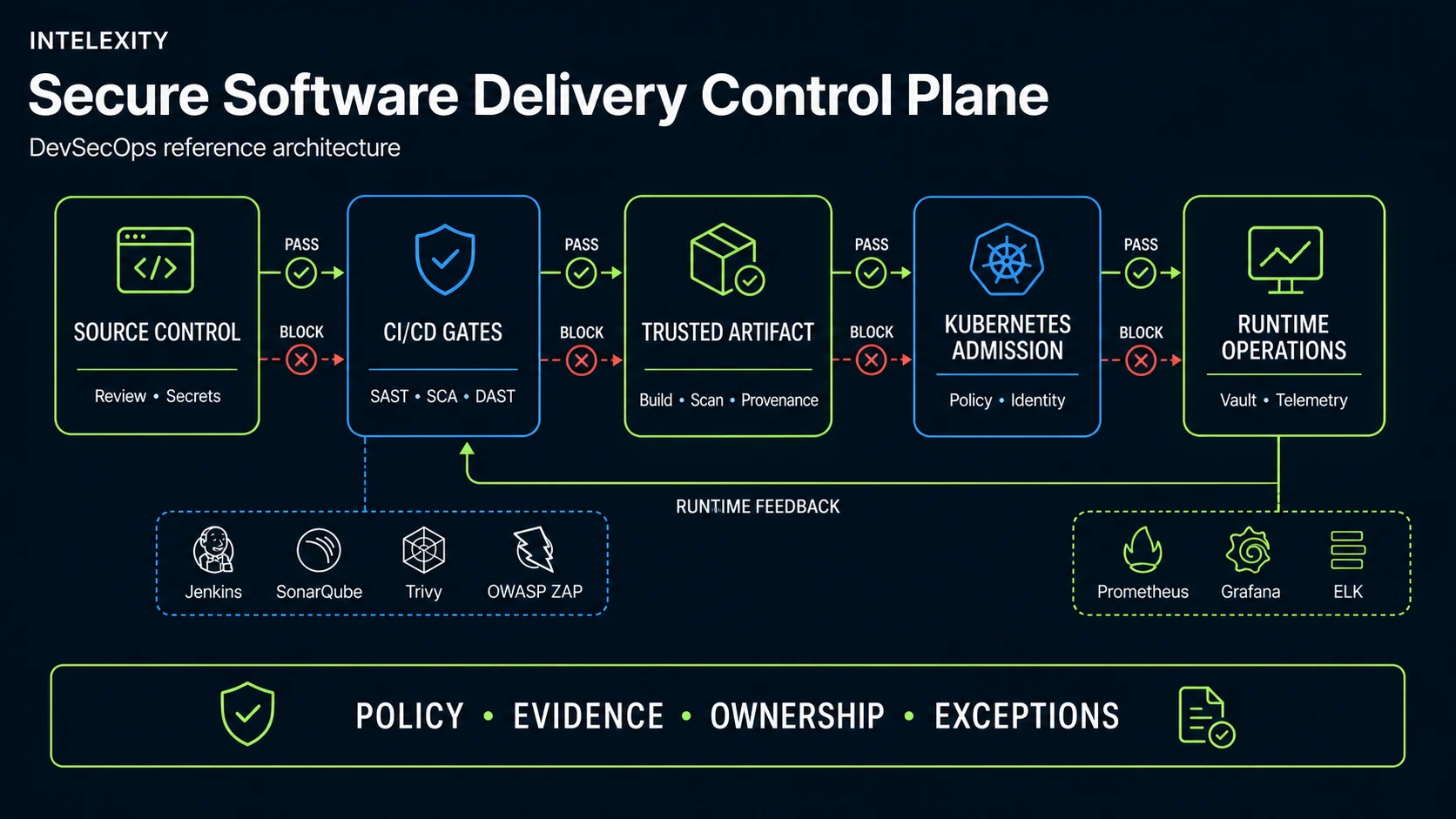
1. Source and change control
The first boundary is the repository. Protected branches, mandatory review, signed commits where appropriate and least-privilege access reduce the chance that an unreviewed change becomes a trusted build input. Secret scanning should run before merge and again in CI because local developer controls are not a reliable enforcement boundary.
Threat modelling belongs here as well. It is difficult to compensate in a pipeline for a design that has no clear trust boundaries, authorization model or failure behavior.
2. Reproducible and isolated builds
A build should consume declared inputs and produce an immutable artifact. Build workers need isolation, short-lived credentials and restricted access to production systems. Dependencies should be pinned or otherwise resolved predictably.
The SLSA framework treats provenance as a central software-supply-chain control: evidence describing what built an artifact, which process was used and which inputs were resolved. Provenance does not prove that software is vulnerability-free. It allows downstream systems to verify that the artifact came from the expected source and build process.
3. Layered security testing
No single test has enough context to represent application risk. A practical pipeline combines several forms of analysis:
- SAST for code-level patterns and unsafe implementation choices;
- SCA for known vulnerabilities and license risk in third-party dependencies;
- container scanning for operating-system packages and image contents;
- infrastructure-as-code checks for dangerous deployment configuration;
- DAST for externally observable application behavior in a running environment;
- targeted manual testing for authorization, business logic and attack paths that automated tools do not understand.
The important architectural decision is where each test runs and what it is allowed to block. Fast, deterministic checks belong early. Slower environment-dependent tests belong after deployment to a representative test environment but before production promotion.
4. Artifact registry and release evidence
Approved artifacts should be stored in a controlled registry and referenced by immutable digest, not by a mutable tag such as latest. The release record can bind together the source revision, build identity, test results, dependency inventory, container digest, approvals and exceptions.
This creates a practical answer to an incident-response question that is otherwise painful: exactly what code and dependencies are running, how were they built, and which controls passed before deployment?
5. Deployment admission
The deployment platform is the final pre-production enforcement boundary. In Kubernetes, admission controls can validate or mutate requests before objects are persisted. Organizations can use this boundary to reject unsigned or unapproved images, privileged containers, forbidden network exposure, missing resource limits or workloads that violate environment policy.
Pipeline approval alone is insufficient if an operator can later deploy a different artifact by hand. Deployment policy must verify the artifact and its evidence again at the point of admission.
6. Runtime identity, secrets and telemetry
Applications should not carry long-lived credentials inside repositories, container images or static environment files. A centralized secrets system can authenticate the workload and issue credentials at runtime. For Kubernetes environments, the Vault Kubernetes authentication model is one example of binding workload identity to controlled secret access.
Runtime telemetry closes the loop. Application logs, platform events, security signals and deployment metadata need enough shared context to connect an incident to a workload, artifact and release. Without this link, “shift left” becomes a one-way process that cannot learn from production.
Implementation in an industrial engineering environment
Intelexity encountered this problem while helping an industrial engineering company integrate security into an existing delivery platform. The environment already used CI/CD, containers and Kubernetes. The gap was not the absence of automation. It was the absence of a consistent security contract across repositories and releases.
Different teams ran different checks. Findings appeared in separate tools. Credentials were handled inconsistently. Operations could observe application health, but security evidence was not reliably connected to a specific artifact or deployment.
The implementation was organized around the delivery path rather than a tool catalogue.
Baseline the existing path
The first step was to map how a change actually reached production: repository permissions, Jenkins jobs, build workers, registries, deployment credentials, Kubernetes namespaces and monitoring systems. This exposed trust boundaries and manual paths that architecture diagrams did not show.
Controls were then classified as blocking, advisory or evidence-producing. The classification depended on exploitability, confidence, workload exposure and the cost of remediation at that stage.
Embed controls into Jenkins
Jenkins remained the pipeline orchestrator. Security checks were integrated into existing jobs instead of creating a parallel security pipeline. SonarQube supported continuous code analysis. Trivy inspected container images. OWASP ZAP covered repeatable dynamic checks, while Burp was reserved for targeted validation where automation lacked application context.
The pipeline produced a consolidated release result instead of forwarding unrelated tool outputs. Teams could see what failed, why it mattered, who owned the next action and whether an exception existed.
Control container promotion
Images were built once and promoted between environments by digest. This removed a dangerous ambiguity: rebuilding “the same version” separately for test and production can produce different artifacts. Scan evidence followed the immutable image through the release path.
Move secrets out of delivery configuration
HashiCorp Vault was integrated with Kubernetes so workloads could obtain secrets at runtime. This reduced the number of people and systems handling static credentials and made secret access part of the platform identity model.
Connect security to operations
Prometheus, Grafana and the ELK stack provided the operational layer. The important work was not installing dashboards; it was attaching consistent service, environment, artifact and release identifiers to telemetry. This allowed an operator to move from a production signal back to the release evidence that introduced it.
The broader lesson applies to other modernization programs. Whether a company is decomposing a legacy platform, introducing a modular core architecture or integrating AI services into existing systems, delivery controls must evolve with the architecture. A faster path to production increases the value of every control that can make a decision automatically and explain it later.
Blocking gates versus advisory controls
The quality of a DevSecOps implementation depends heavily on what it refuses to automate.
Blocking gates should be narrow and defensible. Good candidates include confirmed secrets, forbidden deployment configuration, unapproved artifact identity, missing mandatory evidence and vulnerabilities that exceed a defined risk threshold for the target environment.
Advisory controls are appropriate when confidence is lower or the result needs business context. A static-analysis warning, a dependency with no reachable vulnerable path or a design-level authorization concern may require review rather than an automatic stop.
Exceptions must not become permanent bypasses. A workable exception record contains the affected asset, rule, justification, accountable owner, compensating control and expiration date. The pipeline should re-evaluate the exception on every relevant release.
Metrics that show whether DevSecOps is working
Counting vulnerabilities is rarely useful on its own. An organization that expands scanning coverage may initially discover more findings while becoming materially safer.
Better implementation metrics describe the behavior of the delivery system:
- percentage of production artifacts with verifiable source and build provenance;
- percentage of repositories covered by the minimum control policy;
- time from a high-confidence finding to an owned remediation decision;
- age and recurrence of security exceptions;
- percentage of deployments using immutable approved artifacts;
- time required to identify which releases contain an affected dependency;
- rate of false-positive blocking failures;
- mean time to connect a runtime incident to the responsible release.
These measures reveal whether the system creates control and traceability, not merely activity.
A practical implementation sequence
Attempting to automate every control at once usually creates noise and resistance. A safer sequence is incremental:
- Map one representative service. Document its real source-to-production path and identify unauthorized alternatives.
- Define a minimum release contract. Specify required reviews, tests, artifact identity and evidence.
- Make builds immutable. Build once, store centrally and promote by digest.
- Add high-confidence gates first. Start with secrets, artifact identity and critical configuration violations.
- Centralize exceptions. Give every bypass an owner and expiration.
- Connect deployment and runtime telemetry. Ensure incidents can be traced back to a release.
- Expand by service class. Reuse the platform contract while adjusting policy to workload exposure and data sensitivity.
This approach keeps the platform reusable without pretending that every application has the same risk profile.
DevSecOps is a delivery operating model
The durable result of DevSecOps implementation is not a dashboard and not a long list of scanners. It is a delivery platform that can answer three questions for every production change:
- What exactly are we deploying?
- Which controls and exceptions allowed it to proceed?
- Who can explain and operate the result in production?
When those answers are generated consistently, security becomes part of software delivery rather than an external review applied after the engineering decisions have already been made.